
History and Origin of the Palm Leaf Reading
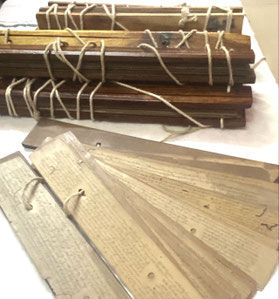

We offer palm leaf readings online. For those who wish to experience this ancient tradition in person, there is also the opportunity to travel to India with me. I now regularly accompany three group trips per year to palm leaf libraries in India. More information can be found in the “Palm Leaf Journeys” section.
For anyone interested in exploring the history and origins of palm leaf reading in greater depth, I recommend the book by tour organizer Thomas Ritter, who has studied this subject for many years from both a scientific and spiritual perspective.
In his research, he describes that there are several palm leaf libraries in India where ancient manuscripts are preserved. According to tradition, these palm leaves date back to the so-called Rishis—highly revered sages of ancient Indian tradition, believed to possess extraordinary spiritual insight. In major Indian epics, they are described as guardians of profound and comprehensive knowledge.
According to this tradition, the Rishis are said to have had access to
a universal memory known as the Akashic Records. From this source, individual life stories were recorded—in ancient Tamil script, inscribed onto dried palm leaves. Since these leaves have limited durability, they have been carefully recopied and preserved over centuries.
Thomas Ritter also draws an interesting parallel between the Rishis of Hindu tradition and the
Mahatmas known from Theosophy. Both are described as carriers of universal wisdom that transcends past, present, and potential future developments. In various spiritual traditions, symbolic places such as Shambhala or Kalapa are also mentioned as representations of timeless knowledge.
Regarding the origin of so-called Nadi readings, Ritter explains that this is a very ancient and specialized form of Vedic astrology. Its focus is less on rigid fortune-telling and more on life guidance. The aim is to help people better understand their life purpose, inner connections, and potential for development—especially during times of crisis or transition.
Regardless of how one interprets these traditions, it can be said that palm leaf reading contains a rich worldview and deep wisdom. It invites reflection on questions of meaning, responsibility, and free will from a broader perspective.
There are numerous books, reports, and analyses on this topic available in English.